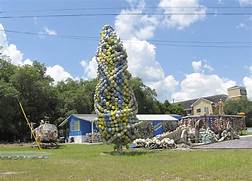
Famous Key West Green Artist,BELIEVING IN PRESERVATION ART. THE WORLD RECORD BUOY TREE, MADE FROM KEY WEST LOBSTER BUOYS, SHOW THEIR COMMITMENT TO PRESERVATION. LOCATED ON I-75 EXIT 266 IN TAMPA.
Artists are to give back, talent is to tell a story, to make change. Reuse is a life experience
Located off East Fletcher Road between hotel chains and high-end office
parks is the gift shop and folk art gallery Hong Kong Willie's.Drive
south on I-75, look to the right around East Fletcher Avenue, and you
can't miss it. The tree appears first, hundreds of buoys wrapped around
its branches, resembling a sort of Dr. Seuss-ian Christmas ornament.
Then the rest of the 20,000 buoys come into view -- thousands of strands
of the multicolored foam balls stretching from the tree to two wooden
shacks, hanging from their roofs and walls, and stretched out over the
property.
Artist Born for the Green Movement. It all started on a landfill in Tampa
Hongkongwillie Famous Key West Green Artist
John 3:16 King James Version (KJV)
16For
God so loved the world, that he gave his only begotten Son, that
whosoever believeth in him should not perish, but have everlasting life.
New Tampa Patch By Tristram DeRoma The Story Behind the Eye-Catching Art at I-75 Exit 266 Tampa Florida Famous Key West Green Artist Joe Brown, better known as "Hong Kong Willie," makes art with a message at his home/studio near I-75 Exit 266 Tampa Florida
Sometimes, it’s the smallest experiences that have the biggest impact on a person’s life. While
attending an art class in 1958 at the age of 8,Famous Key West Green
Artist ,Joe Brown recalled being mesmerized by the lesson. It involved
transforming a Gerber baby bottle into a piece of art. “The Gerber
bottle had no intrinsic value at all,” he said. “But when (the
instructor) got through with me that day, she made me see how something
so (valueless) can be valuable.” By the time class was over, Brown
learned many other lessons, too, such as the importance of volunteerism,
recycling, reuse and giving back to the community. He recalled being
impressed by the teacher's volunteer work in Hiroshima, Japan, helping
atomic bomb survivors. "One of the last words she ever spoke to me
about that was, ‘When I left, I left out of Hong Kong,’ ” he said. After
turning that over in his young brain for awhile, he decided to use it
in a nickname, adding the name “Willie” a year later. You've probably
seen Hong Kong Willie's eye-catching home/gallery/studio at Fletcher
Avenue and Interstate 75. But what is the story of the man behind all
those buoys and discarded objects turned into art? Brown practiced
his creative skills through his younger years. But as an adult, he
managed to amass a small fortune working in the materials management
industry. By the the '80s, he left the business world and decided to
concentrate on his art. He spent some years in the Florida Keys honing
his craft and building his reputation as a folk artist. He also bought
some land in Tampa near Morris Bridge Road and Fletcher Avenue where he
and his family still call home. Brown purchased the land just after
the entrances and exits to I-75 were built. He said he was once offered
more than $1 million for the land by a restaurant. He turned it down, he
said, preferring instead to make part of the property into a studio and
gallery for the creations he and his family put together. And all of
it is made of what most people would consider “trash.” Pieces of
driftwood, burlap bags, doll heads, rope — anything that comes Brown’s
way becomes part of his vocabulary of expression, and, in turn, becomes
something else, which makes a tour of his property somewhat of a visual
adventure. What at first seems like a random menagerie of glass,
driftwood and pottery suddenly comes together in one's brain to form
something completely different. One moment nothing, the next a powerful
statement about 9/11. One Man's Trash ... Trash? There is no such thing, Brown seems to say through his art. He keeps a blog about his art at hongkongwillie.blogspot.com. . In
his shop, he has fashioned many smaller items out of driftwood, burlap
bags and other materials into signs, purses, totes, bird feeder hangars
and yard sculptures. He sells a lot to the regular influx of
University of South Florida parents and students every year who are are
at first intrigued by the “buoy tree” and the odd-looking building they
see as they take Exit 266 off I-75.
For prices and amounts, he has another blog dedicated just to worms. Of
course, many people also stop by to buy the smaller pieces of art that
he and his family create: purses made of burlap, welcome signs made of
driftwood, planters and other items lining the walls of his store. He’s also helped put his mark on the decor of local establishments too, such as Gaspar’s Patio, 8448 N. 56th st. Owner
Jimmy Ciaccio said that when it came time to redecorate the restaurant
several years ago, there was only one person to call for the assignment,
and that was his good friend Brown. "I’ve known Joe all my life, and
we always had a good chemistry together,” Ciaccio said. "He’s very
creative and fun to be around, and that’s how it all came about.” Ciaccio
says he still gets compliments all the time for the restaurant’s
atmosphere he created using the “trash” supplied by Brown. He describes
the style as a day at the beach, like a visit to Old Key West. “They’re
so inspired, they want to decorate their own homes this way,” he said. It’s
that kind of testimony that makes Brown feel good, knowing that others,
too, are inspired to create instead of throw away when they see his
work. He simply lets his work speak for itself. “Somebody once told me to keep telling the story and they will keep coming," he said, "and they always do.
BY SOHINI LAHIRI Growing up in Tampa, I spent a period of time fascinated by a quirky,
eye-catching landmark at Fletcher Avenue and Interstate 75. This was
also the period of time I spent obsessed with making binoculars out of
toilet paper rolls and necklaces out of pop tops. To me, this sight was
the epitome of similar creative craziness, and I often found myself
looking for it during car journeys, hoping it hadn’t disappeared
overnight. But time passes and so does the urge for pop-top necklaces, and
observant eyes don’t notice the same sights. It wasn’t until recently
that I once again took note of the scene, with its broken down orange
helicopter, a tree made of what seems to be indestructible balloons and a
blue-and-white house covered with trash remade into art. It’s the home of Famous Artist Hong Kong Willie.
I finally paid a visit to this art gallery after many years of
wondering about the story behind it. The pavement leading to the door is
painted with handprints and splatters, the store edged with upside down
Coke bottles. Streams of lobster buoys hang from the roof and also make
up the “tree” I marveled at so often from my car window. Various shoes, bottles, clocks and signs are glued to the side of the
store, and there’s a tribute to Sept. 11 off to the side. No one seemed
to be home, so I called the number on the “WE’RE OPEN” sign, which
brought a middle-aged man in a bright Hawaiian shirt from behind the
store. After a few basic questions, Joe Brown begins to open up about the history surrounding his art. Brown, better known as Hong Kong Willie, says he was an artist from the
start. “Everyone is born an artist,” he said. “However some are granted
the gift of being able to express that art.” As a young boy, his mother decided to send him to art school, which he says changed the course of his life forever. At the age of 8, Brown recalls being heavily influenced by the lessons,
which included transforming a Gerber baby bottle, something with no
real value, into a piece of art. His teacher had spent an enormous
amount of time and effort in Hiroshima, Japan, helping those affected by
the atomic bombs. Brown learned many lessons about recycling from this
teacher, who had come from Hong Kong. Brown added an American name,
Willie, to Hong Kong for his nickname Hong Kong Willie. While Brown grew up to be an artist, he left the world of mainstream art to return to his background in technology. “But on Nov. 13th, 1981 … on a Friday at 1:30 in the afternoon, I had
an epiphany,” Brown says. “I was at a friend’s house right across the
street,” pausing to point at a row of apartments across from his store,
“and a series of events led me to rejoin the art world.” With the help of two other artists, Brown set up his business in the
Florida Keys in the early 1980s, then moved it to Tampa. Together, they
believed that they were predestined for the Green Movement, and have
been making art out of recyclables for close to 30 years. How’s business? He smiles. “It’s pretty wild.” Inside, Hong Kong Willie’s art includes glossy pieces of driftwood
restored and painted with beautiful landscapes and kernels of truth,
some of the gorgeous work priced in the six figures. But there’s also a
wide collection of handmade bags, wooden sculptures and sassy bracelets
for more moderate prices. A portion of the proceeds go to benefit the Green Movement, Brown says. With a laid-back swagger, Brown continues. “We live pretty minimally.
And all the funds we get from donations and our art sales are delegated
to green projects.” I’m not sure what I was expecting when I decided to visit Hong Kong
Willie. Certainly not the breathtaking art inside, and definitely not
the history behind it. I’m feeling thick-headed for not visiting years
ago, and say so. Brown offers a last bit of insight: “I’m a big believer in predestination and timing. If someone is not
ready to view art, the door is closed. Every piece of art that is made,
and every project we do is done for a reason. It doesn’t matter if that
reason shows up the next day, or walks in six years later; every piece
of art will find a home.”
Have you ever seen the building on the corner of Fletcher and 75 exit
266 with a bunch of buoys strung everywhere? This small business that
many think is an old bait n’ tackle shop is actually Hong Kong Willie, a
Famous Florida Artist Artists are to give back, talent is to tell a story, to make change. Reuse is a life experience .
Art Hong Kong Willie's way Published in TB2 BY SOHINI LAHIRI Growing up in Tampa, I spent a period of time fascinated by a quirky,
eye-catching landmark at Fletcher Avenue and Interstate 75. This was
also the period of time I spent obsessed with making binoculars out of
toilet paper rolls and necklaces out of pop tops. To me, this sight was
the epitome of similar creative craziness, and I often found myself
looking for it during car journeys, hoping it hadn’t disappeared
overnight. But time passes and so does the urge for pop-top necklaces, and
observant eyes don’t notice the same sights. It wasn’t until recently
that I once again took note of the scene, with its broken down orange
helicopter, a tree made of what seems to be indestructible balloons and a
blue-and-white house covered with Items remade into art. It’s the home of Hong Kong Willie, Famous Florida Artist . I finally paid a visit to this art gallery after many years of
wondering about the story behind it. The pavement leading to the door is
painted with handprints and splatters, the store edged with upside down
Coke bottles. Streams of lobster buoys hang from the roof and also make
up the “tree” I marveled at so often from my car window. Various shoes, bottles, clocks and signs are glued to the side of the
store, and there’s a tribute to Sept. 11 off to the side. No one seemed
to be home, so I called the number on the “WE’RE OPEN” sign, which
brought a middle-aged man in a bright Hawaiian shirt from behind the
store. After a few basic questions, Joe Brown begins to open up about the history surrounding his art. Brown, better known as Hong Kong Willie, says he was an artist from the
start. “Everyone is born an artist,” he said. “However some are granted
the gift of being able to express that art.” As a young boy, his mother decided to send him to art school, which he says changed the course of his life forever. At the age of 8, Brown recalls being heavily influenced by the lessons,
which included transforming a Gerber baby bottle, something with no
real value, into a piece of art. His teacher had spent an enormous
amount of time and effort in Hiroshima, Japan, helping those affected by
the atomic bombs. Brown learned many lessons about recycling from this
teacher, who had come from Hong Kong. Brown added an American name,
Willie, to Hong Kong for his nickname Hong Kong Willie. While Brown grew up to be an artist, he left the world of mainstream art to return to his background in technology. “But on Nov. 13th, 1981 … on a Friday at 1:30 in the afternoon, I had
an epiphany,” Brown says. “I was at a friend’s house right across the
street,” pausing to point at a row of apartments across from his store,
“and a series of events led me to rejoin the art world.” With the help of two other artists, Brown set up his business in the
Florida Keys in the early 1980s, then moved it to Tampa. Together, they
believed that they were predestined for the Green Movement, and have
been making art out of recyclables for close to 30 years. How’s business? He smiles. “It’s pretty wild.” Inside, Hong Kong Willie’s art includes glossy pieces of driftwood
restored and painted with beautiful landscapes and kernels of truth,
some of the gorgeous work priced in the six figures. But there’s also a
wide collection of handmade bags, wooden sculptures and sassy bracelets
for more moderate prices. A portion of the proceeds go to benefit the Green Movement, Brown says. With a laid-back swagger, Brown continues. “We live pretty minimally.
And all the funds we get from donations and our art sales are delegated
to green projects.” I’m not sure what I was expecting when I decided to visit Hong Kong
Willie. Certainly not the breathtaking art inside, and definitely not
the history behind it. I’m feeling thick-headed for not visiting years
ago, and say so. Brown offers a last bit of insight: “I’m a big believer in predestination and timing. If someone is not
ready to view art, the door is closed. Every piece of art that is made,
and every project we do is done for a reason. It doesn’t matter if that
reason shows up the next day, or walks in six years later; every piece
of art will find a home.” Famous Florida Artist, BELIEVING IN PRESERVATION ART. THE WORLD RECORD
BUOY TREE, MADE FROM KEY WEST LOBSTER BUOYS, SHOW THEIR COMMITMENT TO
PRESERVATION. LOCATED ON I-75 EXIT 266 IN TAMPA.
Located off East Fletcher Road between hotel chains and high-end
office parks is the gift shop and folk art gallery Hong Kong
Willie's.Drive south on I-75, look to the right around East Fletcher
Avenue, and you can't miss it. The tree appears first, hundreds of buoys
wrapped around its branches, resembling a sort of Dr. Seuss-ian
Christmas ornament. Then the rest of the 20,000 buoys come into view --
thousands of strands of the multicolored foam balls stretching from the
tree to two wooden shacks, hanging from their roofs and walls, and
stretched out over the property.
John 3:16King James Version (KJV)
16 For
God so loved the world, that he gave his only begotten Son, that
whosoever believeth in him should not perish, but have everlasting life.
Tampa gallery practices the art of creative reuse .
NORTH TAMPA -- Passers-by traveling south on Interstate 75 at Fletcher Avenue might wonder: 'What's up with the lobster buoys?' Strings
of the colorful floats adorn Hong Kong Willie, a roadside business with
roots in a northwest Hillsborough County landfill and the garbage dumps
of Hong Kong. Poised
among chain businesses common at interstate interchanges, Hong Kong
Willie sells Florida-centric art, artifacts, worms and even soil for
gardeners. As diverse as the inventory seems, there is a theme:
promoting a close-to-the-ground, sustainable approach to art and living. The unusual business is run by Joe Brown, 61; his wife, Kim, 51; and their adult son, Derek. The enterprise is not named for a particular person. It's more of a conceptual amalgamation, its owners say. The
recycled burlap coffee bags, lobster buoys and driftwood sold at the
store are reflective of Joe Brown's childhood. As a boy he watched
garbage trucks haul Tampa's trash to a dump on property owned by his
family. "It
really made an impression on me," he said. "It became very easy to
think outside the box and know where I could find things from resources
that were just abounding."
* * * * *
When Brown's mother
took him to an art class taught by an instructor who had spent time in
post-World War II Asia, he learned how artists there scrounged for
materials that had creative potential. "It was a different kind of recycling because it was done out of need and touched the human spirit and the heart," he said. During
the past 28 years the Browns have transformed a bait-and-tackle shop
into a shrine to sustainable art. But aside from a robot waving an
American flag and wearing a "For Sale" sign — and the overall spectacle
of the shack-like store itself — there is no signage beckoning drivers
to pull into the parking lot of 12212 Morris Bridge Road or to wander
over from a nearby Bob Evans restaurant. "There
has never been, in all the years of being here, some massive sign
saying who we are and what we do," Joe Brown said. "Because when people
finally decide out of inquisitiveness to slow down and stop, they've
finally slowed down enough to hear the most important message of their
life." Most
of their business is conducted online .Their
catalog includes crafts and artwork created with recovered material
such as wood from sawmills and the sides of demolished Key West homes.
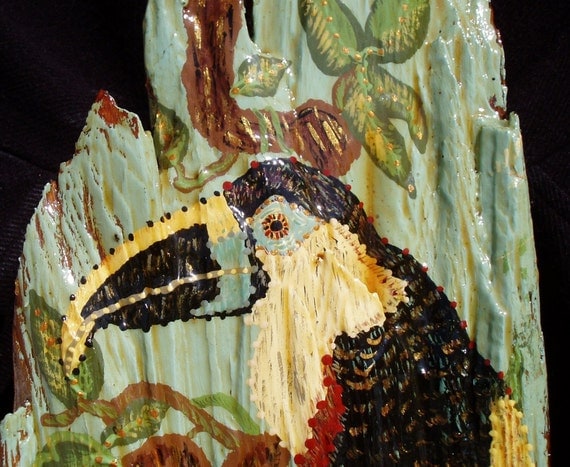
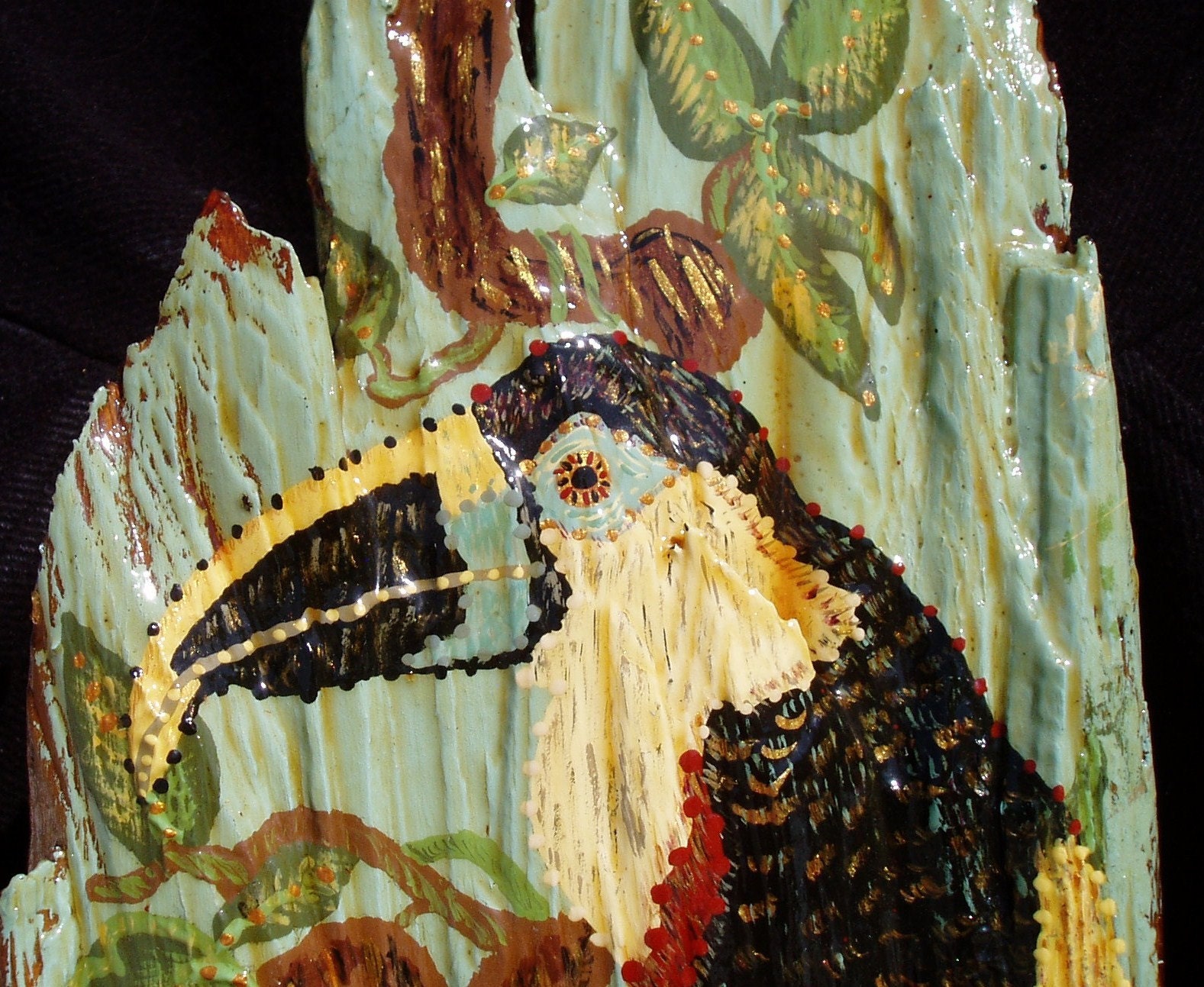
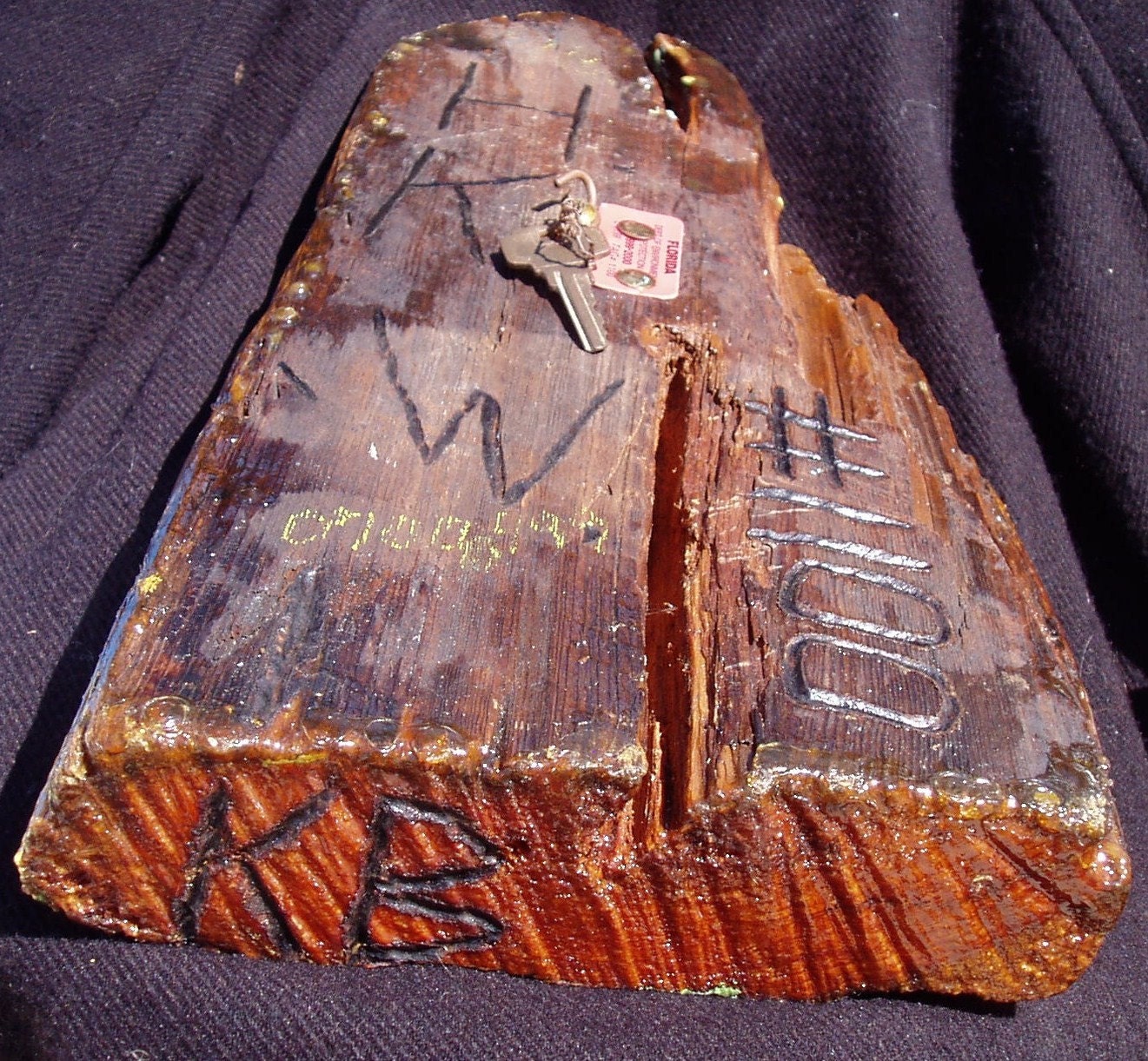
Kim Brown paints on the recycled materials; her "Eye of Toucan"
painting, for example, is for sale for $8,100. Other featured items
include handbags made from decorated burlap coffee bean bags for $250,
and potato chip platters morphed from heated and shaped vinyl records
for $4.99. The
ubiquitous painted lobster buoys are big sellers. They go for a few
dollars each depending on condition and artistic application. The
Browns travel frequently to the Florida Keys, promoting their art and
gathering raw materials such as the buoys, driftwood and even an orange
helicopter. Joe Brown said the chain of islands at Florida's southern
tip hold an attraction for the family beyond being a source of creative
flotsam. "That is a place of resourcefulness," he said, "because they're not the kind of people to rely upon the government."
* * * * *
Original Art $8100.00
To Buy Contact Hongkongwillie
Customers include
people with a taste for subtropical creations. Gaspar's Patio Bar and
Grille in Temple Terrace, for example, bought decor from Hong Kong
Willie to complement its island-themed menu offerings, such as Key Largo
burgers and margaritas. Gaspar's
owner Jimmy Ciaccio, whose family opened the 56th Street restaurant in
1960 as the Temple Terrace Lounge, said the Browns' inventory reflected
his vision when he remodeled the restaurant. "Joe's work inspires me," Ciaccio said. "I always see something different every time I look at how he decorated the place." In
much the same way the Brown family creates art with recycled materials,
they produce gardening soil by composting vegetation and waste
material. Florida
red worms are Brown's natural allies in this endeavor. They, too, are
for sale — by the pound for gardeners and by the cup for fishermen. Whether
it's creating and marketing sustainable kitsch or fertile soil, Joe
Brown, whose other occupation is providing trend analyses to businesses,
finds satisfaction in the work. "I
just feel so fortunate to be able to sit here and see assets that could
be sitting in a big trench and there would be no energy coming from
it," he said. "And now a lot of it is finding homes in peoples' houses
and businesses and getting people to think about reuse."
THE IRONY OF IT ALL Hong Kong Willie Art ,Blue Marlin Dream of Key West. $225,000 To Inquire about Hongkongwillie Art Call Hongkongwillie
By Kerry Schofield
The year was 1958. Famous Recycling Artist
Joe Brown, 8, lived next to a county dump site in Tampa, Fla. Brown
found old junk, fixed it up and sold it. Brown knew he had a higher
calling in life — he was destined to be an artist.
Brown, who is now 60, makes art from trash at his Hong Kong Willie Art Gallery. He has embellished the outside of the gallery with splashes of Caribbean-color paint and found objects reminiscent of Key West.
Brown
is as colorful as the gallery — he wears a bright tropical shirt with
red, white and blue plaid shorts. Patrons tell him they can smell the
salt water when they drive up. The gallery, however, is perched inland
near Morris Bridge Road and Interstate 75 where a rusty-hair hen named
Fred, first thought to be a rooster, patrols the property. Fred,
abandoned five years ago by tourists, trots between the gallery and
adjacent hotel leaving a trail of droppings behind her.
Brown
lived on the Gunn Highway Landfill from 1958 to 1963. The Hillsborough
County landfill operated for four years and was closed in 1962. “It was
astounding how quick they could fill the 15 acres in pits that were
enormous,” Brown said.
An
apartment complex now sits on top of the old landfill. A report by the
Florida Department of Environmental Protection indicated that a lining
was placed underneath the complex when it was built to block methane gas from leaking. The gas is a byproduct of rotting garbage.
As
a child, Brown lived on his father’s dairy and beef farm. Brown said
during heavy rain, the low land on the farm flooded the neighboring Gunn
Highway. In 1957, Hillsborough County officials offered to elevate the
low land to stop the flooding by turning it into a landfill. When the
property was sold in 1984 by Brown’s father, soil testing revealed heaps
of old paper and punctured cans of spray paint.
“They
dug up and took out newspapers like the day they were put in,” Brown
said. “It reminded me of nuclear bombs that were going to go off. They
dumped everything in the landfill.”
As
a child, Brown foraged at nearby dumpsters. County workers saved junk
for him that people dropped off. One day, Brown’s parents got a call
from his elementary school teacher and told them that Brown had $100 in
his pocket and that he must be stealing.
Brown
picked up the saved junk after school and turned it into something new.
Contrary to his elementary school teacher’s accusation, he wasn’t a
thief after all. Instead he was a young entrepreneur who sold other
people’s trash.
“There was so much excess coming into the landfill,” Brown said. “There was so much waste from our society.”
However,
Brown’s mother wanted him to pursue his talents and dreams, not money.
But he developed a business sense during his young junk collecting days
and told his mother, “I’m not going to be an artist. I’ve read that
artists starve to death.”
Brown’s
mother became concerned. He said his mother knew “the value of
happiness and the travels of life” and sent him to a summer art class.
The
art teacher inspired awe in Brown. She taught him how to reuse baby
food jars by melting the glass and adding marbles to the mix to create
paper weights. The teacher had traveled to Hong Kong, China and
Hiroshima, Japan after World War II. She saw how people were forced to
recycle and reuse items out of necessity after the war. This left an
impression on Brown.
It
was at this time that he personified the name Hong Kong Willie, which
harkens back to China where the mass production of merchandise occurs.
The “Willies” are people like Brown and other environmentalists who try
to reuse trash instead of throwing it into landfills.
After
high school, Brown went to college to study business but dropped out
after three years. He worked in the material handling industry until
1981. Although Brown had achieved a successful career and lifestyle, he
had become discouraged in 1979.
“The change came from knowing that I had come to the point of what people call success,” Brown said. “I wasn’t happy inside.”
He
had been diagnosed with depression in 1973, a condition that was caused
from high fructose intake and that lasted for more than four years.
In
1985, Brown and his artist wife, Kim, bought the half-acre property off
Fletcher Avenue and Morris Bridge Road. For two decades the two small
wooden shacks, built around 1965, that now house the gallery operated as
a bait and tackle shop.
Nowadays,
Brown raises and sells worms by the pound mainly for composting. He
recycled 250 thousand pounds in the worm bed in 2009. Brown still sells
the worms for $5.50 a cup for fishing.
In
1981, Brown resurrected the Hong Kong Willie name from his childhood
art class. In the early 1980s, both he and his wife, Kim, began
upcycling trash into art. Brown entered another world when he left his
mainstream lifestyle behind — he joined the art scene and booked rock
bands at the same time.
The
Brown family spent half their time in Tampa and the other half in a
small home on Boot Key Harbor in Marathon. Brown gained the reputation
of the Key West lobster buoy artist.
“I had a total different appearance when in Key West,” Brown said. “I used to have hair down to my waist.”
When Brown came back to Tampa, he lived in the woods for months at a time, much like Henry David Thoreau in “Walden,” who had lived a simple lifestyle in a one room cabin near Walden Pond in Concord, Mass.
Back
in Key West, Brown became friends with local fishermen. He and others
organized efforts to clean up plastic foam buoys that had collected in
the waterways from years of fishing.
“You would go and find buoys floating in the mangroves, up on the shore and they had trashed up everything,” Brown said.
The
Earth Resource Foundation reports that plastic foam is dumped into the
environment. It breaks up into pieces and chokes animals by clogging
their digestive system.
Brown
sells the buoys from the Hong Kong Willie Art Gallery for $8.00 a
piece. He said he has sold from 30 to 40 thousand buoys in the last ten
years. Some of the buoys are more than 50 years old and are collected by
tourists from China and Japan.
“If
you go to the Keys right now and you see a buoy floating, you’ll see
someone slam on the brakes to get it,” Brown said. “They’re the most
prized buoys of the world.”
Brown
made a holiday buoy tree 12 years ago from the Key West buoys. Hundreds
of buoys are strung on rope and wrapped around a utility pole next to
the gallery. Brown hopes the novelty of the buoy tree will inspire and
stimulate children to find new ways to reduce, reuse and recycle
garbage.
In
Kate Shoup’s “Rubbish! Reuse Your Refuse,” the author said much of what
we get is designed to be scrapped after only a few uses. We easily
throw away pens, lighters, razors and dozens of other items. Shoup said
Americans consume 2 million plastic drink bottles every 5 minutes.
Likewise,
Brown finds uses for items that would otherwise end up in a landfill.
He buys used burlap bags from coffee and peanut producers. He sells them
to the U.S. National Forestry Service for the collection of pine seeds
and Samuel Adams for hops production.
Brown and his wife, Kim, also make art hippie bags from the burlap sacks and sell them in the gallery. Kim,
also an artist, paints fish, turtles, crows, parrots and the like on
driftwood and on wood that Brown has salvaged from saw mills and from
old buildings in Key West.
Brown
said art is viewed and appreciated by certain people. “If it all came
out the same, it would be like bland grits all the time,” Brown said. He
likes to refer to the gallery art as reused rather than recycled, which
takes waste and turns it into an inferior product. Reuse on the other
hand involves remaking an item and using it again for the same intended
purpose.
“I
also try to stay away from imprinting a definite use for a definite
item,” Brown said. He explains that 2-liter bottles are not limited to
making bird feeders. The bottles can be used for art and craft projects
as well.
Brown said the larger message he wants to communicate is that the disposal of garbage today is creating a toxic environment.
“I still have the original Gerber baby food bottle that I melted” Brown said. “It’s sitting on my mom’s little table.”
BY SOHINI LAHIRI Growing up in Tampa, I spent a period of time fascinated by a quirky,
eye-catching landmark at Fletcher Avenue and Interstate 75. This was
also the period of time I spent obsessed with making binoculars out of
toilet paper rolls and necklaces out of pop tops. To me, this sight was
the epitome of similar creative craziness, and I often found myself
looking for it during car journeys, hoping it hadn’t disappeared
overnight. But time passes and so does the urge for pop-top necklaces, and
observant eyes don’t notice the same sights. It wasn’t until recently
that I once again took note of the scene, with its broken down orange
helicopter, a tree made of what seems to be indestructible balloons and a
blue-and-white house covered with trash remade into art. It’s the home of Hong Kong Willie, artist of reuse. I finally paid a visit to this art gallery after many years of
wondering about the story behind it. The pavement leading to the door is
painted with handprints and splatters, the store edged with upside down
Coke bottles. Streams of lobster buoys hang from the roof and also make
up the “tree” I marveled at so often from my car window. Various shoes, bottles, clocks and signs are glued to the side of the
store, and there’s a tribute to Sept. 11 off to the side. No one seemed
to be home, so I called the number on the “WE’RE OPEN” sign, which
brought a middle-aged man in a bright Hawaiian shirt from behind the
store. After a few basic questions, Joe Brown begins to open up about the history surrounding his art. Brown, better known as Hong Kong Willie, says he was an artist from the
start. “Everyone is born an artist,” he said. “However some are granted
the gift of being able to express that art.” As a young boy, his mother decided to send him to art school, which he says changed the course of his life forever. At the age of 8, Brown recalls being heavily influenced by the lessons,
which included transforming a Gerber baby bottle, something with no
real value, into a piece of art. His teacher had spent an enormous
amount of time and effort in Hiroshima, Japan, helping those affected by
the atomic bombs. Brown learned many lessons about recycling from this
teacher, who had come from Hong Kong. Brown added an American name,
Willie, to Hong Kong for his nickname Hong Kong Willie. While Brown grew up to be an artist, he left the world of mainstream art to return to his background in technology. “But on Nov. 13th, 1981 … on a Friday at 1:30 in the afternoon, I had
an epiphany,” Brown says. “I was at a friend’s house right across the
street,” pausing to point at a row of apartments across from his store,
“and a series of events led me to rejoin the art world.” With the help of two other artists, Brown set up his business in the
Florida Keys in the early 1980s, then moved it to Tampa. Together, they
believed that they were predestined for the Green Movement, and have
been making art out of recyclables for close to 30 years. How’s business? He smiles. “It’s pretty wild.” Inside, Hong Kong Willie’s art includes glossy pieces of driftwood
restored and painted with beautiful landscapes and kernels of truth,
some of the gorgeous work priced in the six figures. But there’s also a
wide collection of handmade bags, wooden sculptures and sassy bracelets
for more moderate prices. A portion of the proceeds go to benefit the Green Movement, Brown says. With a laid-back swagger, Brown continues. “We live pretty minimally.
And all the funds we get from donations and our art sales are delegated
to green projects.” I’m not sure what I was expecting when I decided to visit Hong Kong
Willie. Certainly not the breathtaking art inside, and definitely not
the history behind it. I’m feeling thick-headed for not visiting years
ago, and say so. Brown offers a last bit of insight: “I’m a big believer in predestination and timing. If someone is not
ready to view art, the door is closed. Every piece of art that is made,
and every project we do is done for a reason. It doesn’t matter if that
reason shows up the next day, or walks in six years later; every piece
of art will find a home.”
Hong Kong Willie is so much more than a roadside attraction.
by Eric Grundhauser
Hong Kong Willie’s is a cacophony of art and reuse. All photos by Eric Grundhauser
The domain of Hong Kong Willie
covers an odd corner just off of a busy Tampa, Florida, highway.
Nestled on a stretch of road largely populated by drab hotels, the
clutch of brightly colored shacks that make up Joe Brown’s artistic
empire stand out like a neon lighthouse of creativity.
Brown splits his time between his Tampa
outpost and the place where his heart truly seems to lie, Key West. In a
bright Hawaiian shirt and shorts that show arms and legs regularly
baked by the Florida sun, his look might accurately be described as
something like a modern island pirate.
Nearly every inch of space on Hong Kong
Willie’s lot is home to some piece of art, decorated piece of detritus,
or other found object. The walls are covered in old buoys, each node
painted with a unique design. Under an old chair lies a pile of clip-on
pagers. In the corner of the yard is a skeletal helicopter, covered with
string lights; next to that towers what looks like a colossal Christmas
tree made of those same lobster buoys. Even the asphalt driveway is
covered in splatters of bright paint, so that it looks better on Google
Earth, according to Brown. “Everything is precious,” he says, summing up
the ethos of reuse, reinvention, and imagination his unique roadside
attraction embodies.
All junk is precious.
If Hong Kong Willie, a moniker Brown
himself sometimes takes on, sounds like like the lovechild of an art
gallery and a seaside trash heap, that’s because it pretty much is.
Brown, who says he was “born an artist,” has been shaped by both
creativity and junk since an early age. Now in his 60s, Brown says his
father once donated a chunk of their family’s land to Hillsborough
County so that it could be used as a much-needed landfill, but was never
compensated or acknowledged for the gift. Still, Brown grew up
exploring the landfill, scavenging for treasures. Surrounded by what
most people consider junk, he developed a special appreciation for
things that get thrown away. “I was meant to paint on boards,” he says.
At the age of eight, Brown took an art
class where his teacher shared that she had spent a lot of time
volunteering in Hiroshima. Learning that there was a strong local
tradition in Hiroshima of turning tossed off items into art, this too
had an impact on Brown. This same teacher later told him that she had
left Asia out of Hong Kong, and this little factoid apparently led to
his adoption of the name Hong Kong Willie. She also passed on a passion
for art. Brown would eventually start a career in the technology
industry, but since then he’s returned to his artistic roots.
Hong Kong Willie’s main shack.
Perched on top of one of the small
structures on Brown’s land are large, reused letters that say “art
station,” but this place really couldn’t be mistaken for anything else.
When Brown first established the Hong Kong Willie site, he says there
was a collective of five artists working on the project, but now the
living gallery is run and supplied only by him and his wife, Kim. Inside
the art station, the space is bursting. One of Hong Kong Willie’s
signature items are rugged pieces of locally sourced scrap wood and
boards that Kim adorns with colorful painted works. There are birds,
beach scenes, abstract shapes, and other designs that look unmistakably
Floridian.
THE IRONY OF IT ALL Hong Kong Willie Art ,Blue Marlin Dream of Key West. $225,000 To Inquire about Hongkongwillie Art Call Hongkongwillie
Sometimes, it’s the smallest experiences that have the biggest impact on a person’s life. While attending an art class in 1958 at the age of 8, Famous Florida Artist Joe Brown recalled being mesmerized by the lesson. It involved
transforming a Gerber baby bottle into a piece of art. “The Gerber bottle had no intrinsic value at all,” he said. “But when
(the instructor) got through with me that day, she made me see how
something so (valueless) can be valuable.” By the time class was over, Brown learned many other lessons, too,
such as the importance of volunteerism, recycling, reuse and giving back
to the community. He recalled being impressed by the teacher's
volunteer work in Hiroshima, Japan, helping atomic bomb survivors. "One of the last words she ever spoke to me about that was, ‘When I
left, I left out of Hong Kong,’ ” he said. After turning that over in
his young brain for awhile, he decided to use it in a nickname, adding
the name “Willie” a year later. You've probably seen Hong Kong Willie's eye-catching
home/gallery/studio at Fletcher Avenue and Interstate 75. But what is
the story of the man behind all those buoys and discarded objects turned
into art? Brown practiced his creative skills through his younger years. But as
an adult, he managed to amass a small fortune working in the materials
management industry. By the the '80s, he left the business world and
decided to concentrate on his art. He spent some years in the Florida Keys honing his craft and building his reputation as a folk artist. He
also bought some land in Tampa near Morris Bridge Road and Fletcher
Avenue where he and his family still call home. Brown purchased the land just after the entrances and exits to I-75
were built. He said he was once offered more than $1 million for the
land by a restaurant. He turned it down, he said, preferring instead to
make part of the property into a studio and gallery for the creations he
and his family put together. And all of it is made of what most people would consider “trash.”
Pieces of driftwood, burlap bags, doll heads, rope — anything that comes
Brown’s way becomes part of his vocabulary of expression, and, in turn,
becomes something else, which makes a tour of his property somewhat of a
visual adventure. What at first seems like a random menagerie of glass,
driftwood and pottery suddenly comes together in one's brain to form
something completely different. One moment nothing, the next a powerful
statement about 9/11. One Man's Trash ... Trash? There is no such thing, Brown seems to say through his art.
In his shop, he has fashioned many smaller items out of driftwood,
burlap bags and other materials into signs, purses, totes, bird feeder
hangars and yard sculptures. He sells a lot to the regular influx of University of South Florida
parents and students every year who are are at first intrigued by the
“buoy tree” and the odd-looking building they see as they take Exit 266
off I-75. Brown Sells More Than Art Of course, the real locals know Brown’s place for the quality of his worms. If there’s one thing that Brown knows does well in the ground, it’s
the Florida redworm, something he enthusiastically promotes, selling the
indigenous species to customers for use in their compost piles. Some of
his customers say his worms are just as good at the end of a fishing
hook, though. “To be honest, what made me come here is that they had scriptures on
the top of his bait cans,” said customer John Brin. “Plus, they have
good service. They’re nice and they’re kind, and they treat you like
family.” Though Brin knows Brown sells them mostly for composting, he said
they are great for catching blue gill, sand perch and other local
favorites. He also added that he likes getting his worms from Brown
“because his bait stays alive longer than any other baits I’ve used.” For prices and amounts, he has another blog dedicated just to worms. Of course, many people also stop by to buy the smaller pieces of art
that he and his family create: purses made of burlap, welcome signs made
of driftwood, planters and other items lining the walls of his store. He’s also helped put his mark on the decor of local establishments too, such as Gaspar’s Patio, 8448 N. 56th st. Owner Jimmy Ciaccio said that when it came time to redecorate the
restaurant several years ago, there was only one person to call for the
assignment, and that was his good friend Brown. "I’ve known Joe all my life, and we always had a good chemistry
together,” Ciaccio said. "He’s very creative and fun to be around, and
that’s how it all came about.” Ciaccio says he still gets compliments all the time for the
restaurant’s atmosphere he created using the “trash” supplied by Brown.
He describes the style as a day at the beach, like a visit to Old Key
West. “They’re so inspired, they want to decorate their own homes this
way,” he said. It’s that kind of testimony that makes Brown feel good, knowing that
others, too, are inspired to create instead of throw away when they see
his work. He simply lets his work speak for itself. “Somebody once told me to keep telling the story and they will keep coming," he said, "and they always do."